
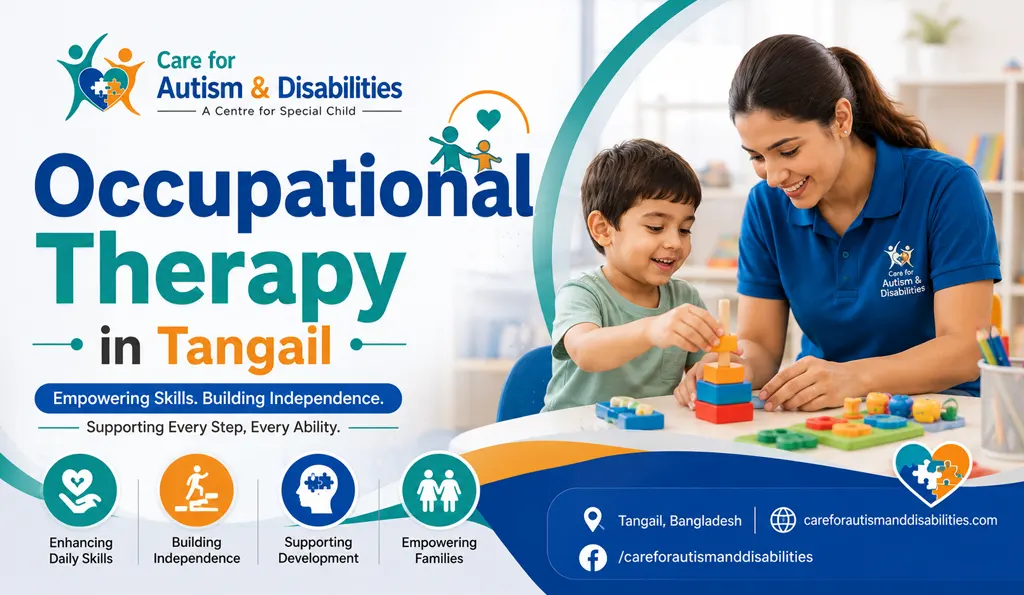
Occupational Therapy in Tangail: Supporting Children’s Independence and Development
Occupational therapy is a structured, goal-oriented intervention that can help children develop functional skills needed for everyday activities, participation, learning, communication, play, and independence. For children with autism, developmental delays, sensory challenges, or difficulties with daily activities, an individualized occupational therapy assessment can help identify specific needs and guide appropriate support.
Families in Tangail seeking structured guidance for their children often turn to pediatric therapy services to address daily functional barriers. Care for Autism & Disabilities provides resources and support for families navigating these developmental challenges.
What Is Occupational Therapy?
Occupational therapy (OT) is a client-centered health profession concerned with promoting health and well-being through occupation. For a child, “occupations” are the everyday activities that bring meaning and purpose to life, including playing, learning, dressing, eating, and interacting with family and peers.
When physical, sensory, cognitive, or developmental barriers interfere with these daily tasks, an occupational therapist works with the child and family to adapt activities, teach practical skills, and modify environments to foster greater self-reliance.
What Does an Occupational Therapist Do?
An occupational therapist evaluates a child’s functional strengths and daily challenges. Rather than focusing solely on isolated physical movements, the therapist analyzes how sensory, motor, cognitive, and environmental factors affect the child’s ability to participate in home, school, and community routines.
Key responsibilities of an occupational therapist include:
-
Evaluating functional performance in self-care, play, and learning.
-
Setting individualized, measurable functional goals alongside caregivers.
-
Designing structured activities to build motor skills, coordination, and task completion.
-
Introducing adaptive strategies or sensory regulation tools tailored to the child’s environment.
-
Educating parents and caregivers on how to reinforce developmental skills during daily routines at home.
Who May Benefit From Occupational Therapy?
Occupational therapy can support individuals across the lifespan, but pediatric occupational therapy specifically targets children who experience difficulties participating in typical daily routines.
A child may benefit from an occupational therapy assessment if they experience challenges related to:
-
Autism Spectrum Conditions: Difficulty with sensory processing, motor planning, social interaction, or adapting to changes in daily routines.
-
Developmental Delays: Delays in reaching age-appropriate motor or self-care milestones.
-
Fine Motor Difficulties: Struggling with tasks that require precise hand movements, such as holding a pencil, using utensils, or manipulating small objects.
-
Self-Care and Dressing Challenges: Persistent difficulty with buttoning shirts, zipping jackets, tying shoes, or managing personal hygiene.
-
Sensory Processing Challenges: Over- or under-reactivity to sensory input (sounds, textures, movement), which affects daily functioning and participation.
-
Coordination and Motor Planning Issues: Difficulty executing multi-step physical tasks, leading to frequent tripping or clumsiness.
-
Handwriting and Academic Tasks: Weak hand strength or poor visual-motor integration impacting writing stamina and classroom activities.
-
Attention and Task Participation: Challenges sustaining attention during multi-step activities or transitioning between daily tasks.
Note: The presence of these characteristics does not automatically mean a child requires occupational therapy. An evaluation by a qualified professional is necessary to determine individual needs.
Occupational Therapy for Children With Autism
For autistic children, occupational therapy plays a crucial role in building functional independence and reducing environmental stressors. Occupational therapy does not aim to “cure” autism; rather, it aims to enhance functional participation, autonomy, and quality of life.
Depending on the child’s profile, OT support may target:
-
Sensory Regulation Strategies: Identifying sensory triggers and establishing environments or routines that help the child maintain a calm, focused state.
-
Self-Care Independence: Breaking down daily activities like bathing, dressing, and brushing teeth into manageable steps.
-
Fine Motor and Handwriting Skills: Developing the hand strength and dexterity necessary for classroom participation and functional tool use.
-
Play and Social Interaction: Facilitating functional and structured play skills, enabling meaningful interaction with peers and family members.
-
Motor Planning and Coordination: Assisting children in understanding and executing complex physical movements involved in play and navigation.
Caregivers are encouraged to work with multidisciplinary teams to ensure strategies are consistently applied across home and learning environments.
Common Goals of Pediatric Occupational Therapy
Pediatric OT focuses on practical, goal-directed outcomes tailored to the child’s age and life context.
| Skill Area | Examples of Support |
|---|---|
| Fine Motor Skills | Grasping utensils, drawing, using scissors, manipulating small buttons/fasteners. |
| Self-Care | Dressing independently, grooming routines, managing hygiene, independent feeding habits. |
| Daily Living | Managing daily schedules, organizing school tasks, following multi-step home routines. |
| Sensory Regulation | Applying calming strategies, adapting spaces for sensory sensitivities, improving focus. |
| Coordination | Visual-motor integration, catching/throwing, hand-eye balance during physical play. |
| School Skills | Pencil grip, handwriting alignment, cutting paper, staying seated during tasks. |
| Play Skills | Engaging in age-appropriate play, tool manipulation, turn-taking during play routines. |
What Happens During an Occupational Therapy Assessment?
An occupational therapy evaluation is a comprehensive process designed to gain a holistic understanding of the child’s functional abilities. While individual center procedures may vary, a standard evaluation typically involves:
-
Caregiver Interview: Gathering information on developmental history, home routines, medical context, and family priorities.
-
Clinical Observation: Observing the child during structured activities, free play, and functional self-care tasks.
-
Standardized and Clinical Measures: Assessing specific skills including fine motor accuracy, visual-motor integration, and sensory profiles.
-
Identification of Strengths and Challenges: Mapping out areas where the child excels and areas requiring targeted intervention.
-
Goal Formulation: Establishing clear, functional goals (e.g., “Child will button a shirt independently within 3 months”).
-
Intervention Planning & Monitoring: Outlining a tailored therapy approach and establishing timelines to review progress.
What Happens During an Occupational Therapy Session?
Occupational therapy sessions are designed to be engaging, child-centered, and purposeful. Activities often resemble play but are structured to target specific developmental outcomes.
A typical session may include:
-
Motor Skill Work: Engaging in clay modeling, bead threading, or drawing to build hand strength and control.
-
Functional Self-Care Practice: Practicing dressing routines using adaptive clothing, unzipping backpacks, or handling utensils.
-
Sensory-Based Activities: Utilizing heavy work activities, deep pressure techniques, or movement exercises when clinically indicated to support regulation.
-
Visual-Spatial and Handwriting Exercises: Tracing shapes, completing mazes, and practicing letter formations to improve classroom performance.
-
Play Routines: Structured games designed to improve turn-taking, motor planning, and functional interaction.
Therapists continuously adjust the challenge level of each task to keep the child engaged while building skill competence.
Occupational Therapy vs. Physiotherapy vs. Speech & Language Therapy
Parents often seek clarification regarding the differences between allied health disciplines. While they frequently collaborate, each therapy targets distinct areas of development:
| Therapy Type | Primary Focus | Common Goals |
|---|---|---|
| Occupational Therapy | Functional independence, daily living tasks, fine motor skills, sensory strategies. | Dressing, handwriting, using tools, self-regulation, play participation. |
| Physiotherapy | Gross motor development, large muscle groups, overall movement, posture, and balance. | Walking, running, jumping, balance training, physical strength, posture control. |
| Speech & Language Therapy | Expressive and receptive communication, speech clarity, non-verbal communication, swallowing/feeding support. | Spoken language, picture communication systems, speech articulation, safe swallowing. |
These therapies complement each other. A child with complex developmental needs may work with multiple professionals simultaneously to achieve cohesive goals.
Signs a Child May Benefit From an OT Assessment
The following non-diagnostic checklist highlights functional signs that may indicate a child could benefit from an occupational therapy evaluation:
-
Has significant difficulty using pencils, crayons, scissors, or small tools appropriate for their age.
-
Struggles continuously with dressing, buttoning, zipping, or tying shoes compared to peers.
-
Shows extreme sensitivity—or complete lack of response—to specific sounds, textures, clothing tags, or light touch.
-
Frequently trips, bumps into objects, or displays unusually poor physical coordination.
-
Avoids tasks that require fine motor manipulation or hand strength.
-
Displays notable frustration during multi-step daily routines like washing hands or packing a school bag.
-
Has difficulty maintaining balance, posture, or stability while sitting at a table.
These signs do not automatically mean a child requires therapy. A qualified healthcare professional should conduct a complete assessment to determine appropriate steps.
How Occupational Therapy Supports Independence
The primary objective of pediatric occupational therapy is practical autonomy. By breaking down complex tasks into manageable steps, OT helps children transition from reliance on caregivers to functional independence.
-
Self-Care Autonomy: Enables children to handle personal routines like dressing and eating independently.
-
Academic Participation: Equips children with the physical and organizational tools needed for classroom environments.
-
Home Routine Ease: Helps families create smooth morning, mealtime, and bedtime routines, reducing stress for caregivers.
-
Self-Esteem and Confidence: Mastery of basic daily tasks builds a sense of efficacy and self-confidence in growing children.
Occupational Therapy in Tangail
Accessing quality developmental services close to home is essential for consistent care. For families looking for pediatric occupational therapy in Tangail, local options offer structured support tailored to individual family needs.
Care for Autism & Disabilities serves as an informational resource and service provider for families navigating developmental needs, autism, and child therapy in Tangail, Bangladesh. Local resources allow families to receive long-term, accessible interventions without the burden of constant long-distance travel.
How to Choose an Occupational Therapy Center in Tangail
When selecting a therapy center for your child, consider the following practical criteria:
-
Qualified Staff: Ensure the center works with qualified, trained occupational therapy professionals.
-
Individualized Assessments: Look for centers that create customized intervention plans rather than one-size-fits-all programs.
-
Caregiver Involvement: Choose facilities that encourage parent communication, home program guidance, and progress tracking.
-
Safe, Clean Environment: Verify that the therapy spaces are secure, sanitary, and equipped with appropriate functional therapy materials.
-
Transparent Service Delivery: Confirm that therapy goals, schedules, and fee structures are clearly explained.
-
Interdisciplinary Coordination: Select centers capable of coordinating care with pediatricians, educators, and other therapists.
Frequently Asked Questions
What is occupational therapy for children?
Occupational therapy for children focuses on developing the physical, sensory, cognitive, and motor skills required to perform daily functional tasks such as dressing, eating, playing, writing, and participating in school routines independently.
What does occupational therapy help with?
OT helps children overcome challenges with fine motor skills, sensory regulation, self-care routines, hand-eye coordination, emotional self-regulation, handwriting, and functional participation in home and school environments.
Is occupational therapy useful for children with autism?
Yes. Occupational therapy is widely used to support autistic children by helping them develop sensory regulation strategies, improve self-care capabilities, enhance motor planning, and foster independent participation in daily life routines.
What age can a child start occupational therapy?
A child can start occupational therapy at any age, including early infancy. Early intervention often yields strong outcomes by addressing developmental delays during early neurodevelopmental stages.
How long does an occupational therapy session last?
Most pediatric occupational therapy sessions last between 45 to 60 minutes, depending on the child’s age, attention span, and individual therapy plan.
How often should a child receive occupational therapy?
Session frequency varies based on individual clinical recommendations. Many children attend therapy 1 to 3 times per week, complemented by home activity programs carried out by caregivers.
Does every child with autism need occupational therapy?
No. Therapy needs are highly individual. An autistic child only requires occupational therapy if an assessment indicates specific functional, sensory, or motor barriers in their daily activities.
What happens during an OT assessment?
An OT assessment involves parent interviews, observational evaluations of the child during play and functional tasks, clinical measurements of motor/sensory skills, and setting clear, personalized goals.
What is the difference between OT and physiotherapy?
OT focuses on functional skills, sensory integration, and independence in daily tasks (like writing or dressing), whereas physiotherapy focuses primarily on gross motor development, balance, strength, and physical mobility (like walking or running).
Where can I find occupational therapy in Tangail?
Families in Tangail can explore local options like Care for Autism & Disabilities for guidance, developmental screening, and access to special child therapy services.
Can occupational therapy help with self-care skills?
Yes. OT directly addresses daily living skills such as independent eating, grooming, buttoning clothing, tying shoes, and completing hygiene routines through task breakdown and motor practice.
How can parents get started with occupational therapy?
Parents can start by scheduling an evaluation with a developmental professional or occupational therapist, discussing functional concerns, and participating in a baseline assessment.
Learn More and Get Guidance
If you are looking for information on occupational therapy in Tangail for your child, explore the available services and educational resources at Care for Autism & Disabilities. Connect with local resources to discuss your child’s specific developmental goals and determine the appropriate path forward.
