
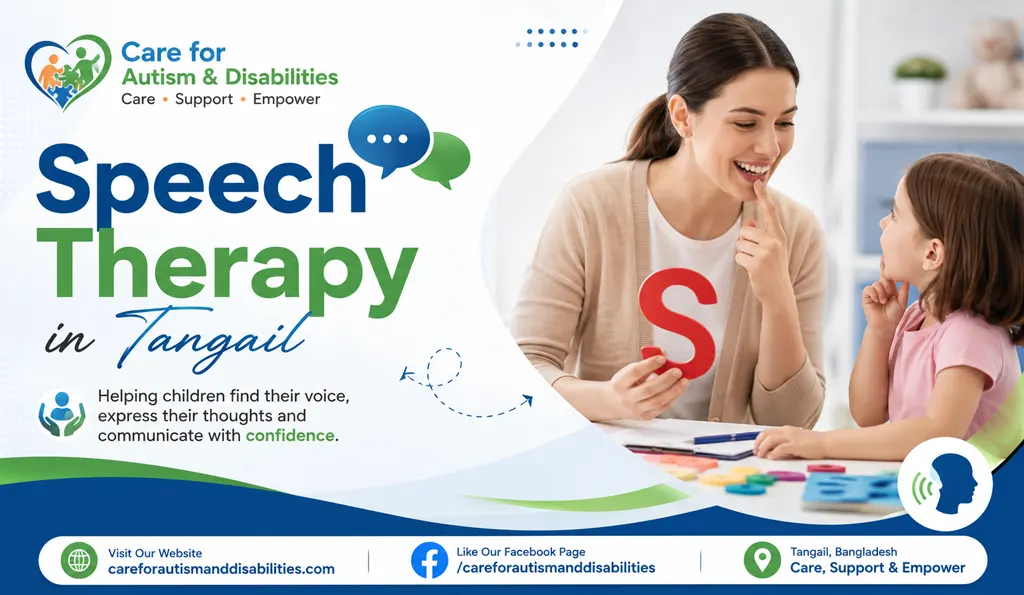
Speech Therapy in Tangail: A Complete Guide for Parents in 2026
Watching your child grow and learn new words is one of the most exciting parts of parenting. But when speech seems delayed, or when your child struggles to make clear sounds or express what they need, it can naturally bring up worry and questions. If you are looking into Speech Therapy in Tangail, knowing what support is available locally can help you take clear, confident steps for your child.
In Tangail, Care for Autism & Disabilities (CAD) offers dedicated Speech and Language Therapy alongside Occupational Therapy and Physiotherapy. CAD helps children and individuals build everyday communication skills, overcome speech sound difficulties, and navigate developmental delays with practical, supportive care.
What Is Speech Therapy?
Speech therapy is a practical, supportive form of care that helps people speak more clearly, understand spoken language better, and share their thoughts with confidence. It goes far beyond simply pronouncing words correctly it focuses on the full picture of how we connect and communicate with others.
A speech therapist helps children and individuals work on several core areas:
- Speech Sounds & Clarity: Helping children learn how to move their lips, tongue, and jaw to articulate sounds clearly.
- Understanding Language (Receptive Language): Building a child’s ability to follow directions, understand questions, and process what people are saying.
- Expressing Thoughts (Expressive Language): Teaching children how to put words together, build vocabulary, and form complete sentences.
- Social Communication: Guidance on turn-taking during conversations, understanding body language, and using words naturally with family and friends.
- Speech Flow & Rhythm: Addressing stuttering or hesitation so speech feels smoother and less frustrating.
- Voice Health: Helping with issues related to pitch, volume, or vocal strain.
Who May Need Speech Therapy?
Every child grows on their own timeline, but when communication barriers make daily life frustrating at home or school, specialized speech support can make a noticeable difference.
Speech and language support is often helpful for children or individuals experiencing:
- Speech Delay: Using noticeably fewer words than other children their age or taking longer to start speaking.
- Unclear Pronunciation: Struggling with specific letter sounds, making it hard for family members or teachers to understand them.
- Trouble Putting Words Together: Finding it hard to build complete sentences or express full ideas.
- Difficulty Following Instructions: Struggling to process simple, multi-step directions at home or in class.
- Frustration When Communicating: Becoming upset or shutting down because they cannot make their wants or needs understood.
- Social Communication Challenges: Finding it difficult to join in play with peers, make eye contact, or take turns in conversation.
- Developmental Differences: Communication challenges connected to autism spectrum conditions, global delays, or physical conditions.
Having one or more of these difficulties does not automatically mean a child has a lifelong disorder. A formal assessment simply helps pinpoint where your child is right now and what kind of practice will help them move forward.
Signs Your Child May Benefit From an Assessment
It is completely normal for children to reach speech milestones at slightly different times. However, keeping an eye on how your child communicates during daily activities can help you notice when a little extra support might be useful.
Here are a few common signs organized by age group:
- Around 12 to 18 Months:
- Uses very few gestures like pointing, waving, or shaking their head.
- Does not react much to familiar voices or sounds in their environment.
- Rarely attempts to use simple words like “mama” or “baba.”
- Around 2 Years:
- Uses fewer than 50 spoken words on a regular basis.
- Does not put two words together spontaneously (like “more milk” or “go out”).
- Has difficulty understanding simple requests like “come here” or “give me the ball.”
- Around 3 Years:
- Speaks in a way that is very difficult for immediate family members to understand.
- Rarely asks simple questions or uses short 3-word sentences.
- Seems uninterested in interacting or playing alongside other children.
- 4 Years and Older:
- Frequently swaps or drops speech sounds, making them hard to understand for people outside the home.
- Shows frequent stuttering, repeating the first sound of words repeatedly.
- Shows clear signs of anxiety or frustration whenever they try to speak.
If you recognize these signs, discussing your observations with a qualified specialist at a local [therapy centre in Tangail] can give you clear answers without unnecessary worry.
Speech Therapy in Tangail — What Services Are Available?
Parents in Tangail no longer need to travel to larger cities for regular therapy sessions. Local centers offer structured care tailored to each child’s individual needs.
Services commonly available through local speech clinics include:
- Speech & Language Evaluations: Detailed initial assessments to map out a child’s current communication strengths and areas for growth.
- Articulation & Sound Therapy: Fun, focused exercises to help children practice tongue and lip placements for clearer speech.
- Language Building Programs: Structured play to boost vocabulary, sentence building, and listening comprehension.
- Functional Communication Support: Helping non-verbal or minimally verbal children express daily needs through words, gestures, or visual picture tools.
- Social Communication Groups: Guided group settings where children practice sharing, taking turns, and conversing with peers.
- Parent Coaching & Home Guidance: Teaching parents practical ways to encourage speech during ordinary daily routines.
Care for Autism & Disabilities (CAD) provides these specialized services right in Tangail, giving families access to consistent, high-quality care close to home.
Speech Therapy for Children in Tangail
Children learn best when they are having fun and feel safe. [Child Speech Therapy in Tangail] focuses on play-centered activities that feel like games rather than strict classroom lessons.
Effective child-focused therapy rests on a few key pillars:
- Personalized Goals: Every exercise is tailored specifically to your child’s current abilities and interests.
- Play-Based Learning: Using toys, storybooks, and interactive games to make practicing speech feel natural.
- Active Family Involvement: Parents are kept involved so that learning doesn’t stop when the session ends.
- Consistent Practice: Short, regular practice sessions build lasting habits much faster than rare, long sessions.
- Tracking Small Wins: Regularly reviewing progress so therapy can adapt as your child grows and gains new skills.
Speech Therapy for Children With Autism in Tangail
Autistic children communicate in wonderfully diverse ways. Some may speak fluently about topics they love but find back-and-forth conversation tricky. Others may be non-verbal or use repeated phrases (echolalia) to process what they hear.
Autism-focused speech therapy respects these individual differences and concentrates on meaningful, everyday communication:
- Functional Communication First: Ensuring your child can easily communicate basic wants, comfort, and choices using speech, gestures, or visual tools.
- Flexible Language Building: Helping children who learn language in blocks or scripts gradually build flexible, spontaneous sentences.
- Social Pragmatics on Their Terms: Guiding children on how to navigate peer interactions and social settings comfortably.
- Sensory Awareness: Designing sessions that respect your child’s sensory comfort levels so they can stay calm and focused.
Therapy is not meant to “cure” autism or force a child to fit a rigid mold. Its true goal is to lessen daily frustration and give children tools to share their world with others. Care for Autism & Disabilities (CAD) incorporates these practical, compassionate frameworks for families in Tangail.
What Happens During a Speech Therapy Session?
Knowing what to expect can help both you and your child feel completely relaxed before your first visit.
- Friendly Assessment & Discussion
Gathering developmental history and observing natural communication|
- Setting Clear, Practical Goals
Defining clear milestones together with parents
- Interactive Play & Therapy Exercises
Guided games, cards, and stories targeting speech & language
- Parent Feedback & Easy Home Activities
Reviewing what worked well and planning simple home practice
- Initial Assessment: The therapist chats with you about your child’s history, observes how they communicate, and assesses their current speech patterns through simple activities.
- Goal Setting: Together, you and the therapist decide on clear, reachable goals (for example, learning 10 new daily words or pronouncing the “S” sound clearly).
- Targeted Activities: The clinician guides your child through fun, interactive exercises designed to practice specific communication targets.
- Parent Feedback & Home Plan: At the end of the session, the therapist explains what went well and gives you easy strategies to try at home.
- Ongoing Review: Goals are adjusted periodically as your child hits new milestones.
Benefits of Speech and Language Therapy
With consistent sessions and home practice, speech therapy can open up meaningful improvements in a child’s daily life:
- Clearer Daily Communication: Helps family members and teachers understand what your child is saying without constant guessing.
- Better Understanding: Strengthens comprehension so your child can follow routines and instructions easily.
- Richer Vocabulary: Helps children learn and use new words to form complete, meaningful sentences.
- Greater Confidence: Reduces the sadness and frustration children feel when they struggle to make themselves understood.
- Easier School Transition: Prepares young children for listening, reading, and interacting in classroom settings.
- More Independence: Empowers individuals to express their own feelings, preferences, and choices.
How to Choose a Speech Therapist in Tangail
Finding the right professional for your family is an important step. Here are practical points to keep in mind when looking at a [Speech Therapy Center in Tangail]:
- Qualified Professionals: Check that clinicians have formal training and credentials in speech and language therapy.
- Thorough Assessments: Look for centers that take time to evaluate your child fully rather than rushing to conclusions.
- Customized Plans: Make sure therapy plans are built specifically around your child’s individual needs.
- Parent Partnership: Pick a center that welcomes parents into the process and gives practical home guidance.
- Welcoming Environment: The clinic space should feel clean, bright, and child-friendly to help young children feel at ease.
- Comprehensive Care: Centers that also offer complementary services—such as [Occupational Therapy in Tangail] or [Physiotherapy in Tangail]—can make life much easier if your child needs multi-disciplinary care.
Why Choose Care for Autism & Disabilities (CAD)?
Care for Autism & Disabilities (CAD) is a dedicated local therapy center located in Tangail, Bangladesh.
Here is what families appreciate about CAD:
- Right Here in Tangail: Convenient local access means less time spent traveling and more energy focused on your child’s growth.
- Core Speech Services: Dedicated programs for speech delay, articulation issues, language development, and social communication.
- Multi-Therapy Support: Along with speech and language services, CAD offers [Physiotherapy in Tangail] and Occupational Therapy under one roof.
- Focus on Child Development: Specialized experience helping children with developmental differences, including autism, build functional life skills.
- Parent-Friendly Approach: Clear, honest communication that empowers parents to support their child at home.
Speech Therapy vs. Language Therapy
Though often grouped together, speech therapy and language therapy actually target two different parts of communication.
| Feature | Speech Therapy | Language Therapy |
|---|---|---|
| What It Focuses On | The physical mechanics of producing sounds, voice control, and speech flow. | Understanding, organizing, and using words to share ideas. |
| Common Examples | Correcting a lisp, pronouncing “R” or “S” sounds clearly, easing stuttering. | Building vocabulary, learning to form full sentences, following directions. |
| Main Goal | Improving how words and sounds physically come out of the mouth. | Improving what words mean and how they are structured logically. |
How Often Should a Child Attend Therapy?
There is no one-size-fits-all schedule for speech therapy. How often your child attends depends on several factors discussed during your initial evaluation:
- Your Child’s Needs: The amount of direct support required for sound clarity or language building.
- Clinical Goals: The specific milestones set by you and the therapy team.
- Age & Focus: Younger children usually do best with shorter, regular sessions.
- Home Consistency: Children who practice regularly at home often make steady progress with standard weekly visits.
- Professional Guidance: Your therapist will suggest a routine based on how your child responds over time.
Simple Ways Parents Can Support Speech at Home
As a parent, you are your child’s most natural communication teacher. Everyday moments at home are perfect opportunities to build language skills naturally:
- Talk Through Daily Routines: Describe what you are doing while cooking, dressing, or shopping using simple, clear words.
- Follow Their Interests: Pay attention to what catches your child’s eye and talk about those exact items or actions.
- Read Stories Together: Look at picture books, point to objects, and ask casual questions as you flip the pages.
- Give Them Time to Respond: Count to 5 or 10 silently in your head after asking a question so your child has time to think and answer.
- Model Clear Language: Instead of scolding a mispronounced word, simply repeat the phrase correctly (e.g., if your child points and says “look, big doggy woof,” you can say “Yes! That is a big doggy!”).
- Celebrate Communication Attempts: Praise every effort your child makes to communicate, whether through words, gestures, or signs.
- Practice Home Recommendations: Spend 5 to 10 minutes a day on the simple activities suggested by your therapist.
When Should You Seek Professional Help?
If you ever feel unsure about your child’s speech or language development, trust your instincts. Reaching out for a professional opinion does not mean something is wrong—it simply gives you clarity, expert feedback, and peace of mind.
Visiting a specialized [therapy centre in Tangail] allows you to ask questions, understand where your child stands developmentally, and catch any potential issues early when support is most effective.
Frequently Asked Questions About Speech Therapy in Tangail
1. What is speech therapy?
Speech therapy is a supportive health service that helps individuals improve speech sound clarity, language comprehension, sentence building, fluency, and social communication.
2. Where can I find speech therapy in Tangail?
You can find dedicated speech and language therapy services in Tangail at Care for Autism & Disabilities (CAD).
3. What does a speech therapist do?
A speech therapist evaluates communication needs, creates personalized goal plans, and leads fun, interactive activities to help individuals speak clearly and express themselves effectively.
4. Is speech therapy suitable for young children?
Yes. Speech therapy for children uses gentle, play-based methods that feel like fun games while encouraging natural language growth.
5. Can speech therapy help with speech delay?
Yes. Speech therapy identifies the underlying reasons behind speech delays and guides children step-by-step to build their vocabulary and speaking skills.
6. Is speech therapy helpful for autistic children?
Yes. Speech therapy provides autistic children with functional communication tools—whether verbal, visual, or gestural—tailored to their unique communication style.
7. How long does it take to see progress in speech therapy?
Timelines vary for every child. Progress depends on individual needs, regular attendance, and how consistently strategies are practiced at home.
8. How often will my child need to attend sessions?
Session frequency is decided after your child’s initial evaluation based on their specific needs and therapist recommendations.
9. What happens during the first assessment?
The therapist talks with parents, reviews developmental background, observes the child’s communication habits, and uses simple activities to assess speech and language skills.
10. How can I help my child build speech skills at home?
You can support growth by talking through daily chores, reading interactive books together, modeling clear speech, giving extra response time, and following your therapist’s home advice.
Speech Therapy in Tangail — Why Early Support Matters
Addressing communication difficulties early gives children the confidence and tools they need to express themselves, make friends, and thrive at school. Every child learns at their own pace, and having compassionate, local professional guidance makes the journey smoother for the entire family.
If you have questions about your child’s speech, language, or overall developmental progress, reaching out to a local team is a practical, supportive first step.
Book a Speech and Language Assessment in Tangail
If you are looking for an empathetic, professional [Speech Therapist in Tangail], Care for Autism & Disabilities (CAD) is here to help your family.
CAD provides comprehensive developmental services in Tangail, Bangladesh, including:
- Speech and Language Therapy
- Occupational Therapy
- Physiotherapy
Take a confident step forward for your child’s communication journey by contacting [Care for Autism & Disabilities] to arrange a professional assessment today.
Speech Therapy See Similar
- Autism
- Cerebral Palsy
- Speech (General Speech Disorders)
- Autistic (Features /Traits)
- Stammering / Stuttering
- Post-Stroke Speech Rehabilitation
- Forgetting Learned Words /Speech (Cognitive-Communication Issues)
